
Pic Courtesy – https://www.personaldevelopmenttoolbox.net/success/40-powerful-ways-to-self-sabotage-your-success/attachment/internal-conflict/
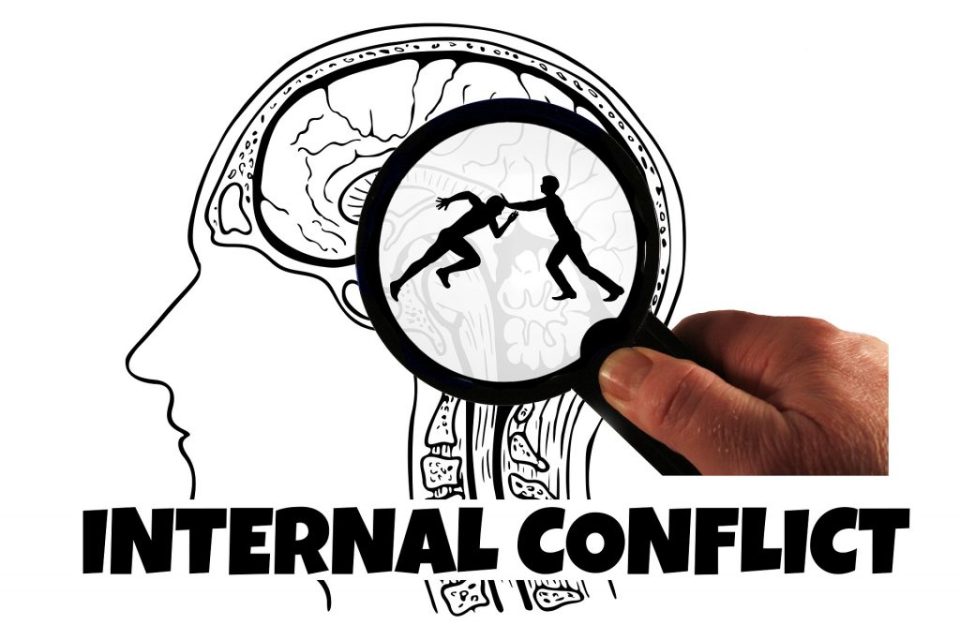
We have seen that irritation and frustration are the outcome of self-declared failures in life. They are the kind of obstacles that once creep into our minds, attitudes, and temperament, and are not easy to overcome. This attitude in itself is indicative of self-defeat, which consequently triggers the germination or precipitation and regular increase of stress and strain. Further, this leads to a conflict between the drive and the obstacle, like two opposite poles or different motives alive at the same point and in the same time zone. Each one is clamoring for its satisfaction creating a disconnect. The disconnect between our behavior, beliefs, values, and circumstances is the cause of our inner conflicts. Internal conflicts are contradictions between a closely held value and a course of action.
_______________________________________________________________________
Read Also: EMBRACING SUSTAINABLE SOLUTIONS: PAVING THE PATH TO UNDOING ENVIRONMENTAL DAMAGE!!
________________________________________________________________________
This inner state of mind characterized by tension is the result of the presence of mutually exclusive but opposing tendencies, impulses, desires, beliefs, or values. The whole process breeds a web of dilemmas and finally converts into mental conflict.Sometimes we can see how seemingly small choices feel like they have earth-shattering consequences. The state of stress or tension makes it difficult for the individual to choose or to make a decision. He always hesitates, vacillates, or oscillates between two or more courses of action.Most of the time one can’t decide at all because of the fear of failure arising out of this confusion. This inner turmoil is known as “Cognitive Dissonance”. In these situations despite knowing the facts, people change their explanations to justify their behavior.
We can break internal conflict into three major patterns of disconnect. The first type of internal conflict is one in which two goals but different are desired at one time. But the simultaneous attainment of the two is impossible. One belief opposes the other.The second can be illustrated by an individual who wants and does not want at the same time. A son may have both love and hate for his father. He may be torn between morality, loyalty, and aggression. Both choices require some degree of sacrifice, no matter what he chooses.The third type of internal conflict is one in which an individual does not want to do a thing but is forced to do a thing. An employee in a company hates to work on an assignment but has the fear of losing the job. In addition to these, we have social, religious, spiritual, political, and other miscellaneous conflicts.
_______________________________________________________________________
Read Also: FOR OUR EXISTENCE AND SURVIVAL, WE MUST LEAVE VANITY AND ACCEPT HUMANITY.
________________________________________________________________________
Bring in mind a conflict, and we will have the perpetrator in mind. But, if we want to manage conflict in life, we will have to understand the situation and our role in it. We always strive to gratify our wants desires, aims, and ambitions. Sometimes our ambitions exceed our abilities or we misperceive the possibilities. Sometimes we are blocked by external barriers that preclude gratification. In the case of blockage of our wants or goals, we alter or adjust our aim automatically. Frustration signals the error in the trial and error process by which we dialectically adjust our perspectives to external powers and potentialities. So, occasional obstacles in professional life or a healthy dose of frustration can be good.But when we are buried in an avalanche of problems, it becomes difficult to handle the situation, and we become chronically frustrated in life. Chronic frustration often morphs into fear and anger.
Dealing with emotions of anger and thoughts of despair can cause anyone to lose his balance. Often when we get upset, we are tempted to react impulsively and do not think rationally and logically about the situation. But we always have options before life becomes too heavy at any given time. It is always better if we help ourselves and others in that very situation when life plays out of control. We can engage ourselves in more purposeful activities to give life a deeper and more meaningful dimension. In difficult situations, we must not get upset by what we face, but staying equanimous as much as possible is the crux to living a minimum conflict-free life.
_______________________________________________________________________
Read Also: WHAT KIND OF LIFE DO WE WANT ON THIS EARTH?
________________________________________________________________________
Tags: #aggresion, #anxietyrelief, #biochar, #climate, #climatechang, #communication, #conflict, #environment, #getgreengetgrowing, #globalwarming, #gngagritech, #greenstories, #history, #historyofviolence, #nature, #selfawareness, #triggers, #war