
https://cpaws-sask.org/carbon-sequestration/
Land clearance for agricultural and animal production produced roughly 136,000 million tonnes (tCO2e) of greenhouse gas emissions from the Industrial Revolution to the Modern World. Even in today’s world, human activities such as the burning of fossil fuels and other sources of pollution account for more than 13% of total emissions. As a result, the Biosequestration idea offers a breath of fresh air for the regeneration of damaged and cleared land.
________________________________________________________________________
Read Also : SHOULD WE CONSERVE HYBRIDS?
________________________________________________________________________
- It has the potential to trap enormous amounts of carbon at a minimal cost.
- The soils, water resources, habitat, and biodiversity will be protected or improved.
- It improves rural income.
- It encourages more environmentally friendly agricultural and forestry operations.
- Land that has more carbon tends to be more productive than land that contains less carbon. More biological activity typically implies more carbon, which has a number of positive benefits on output.
Biosequestration
https://climable.org/blog/2020/5/18/carbon-sequestration
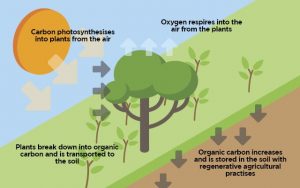
The method of trapping and storing carbon in living organisms such as plants and algae is known as biosequestration. It’s not a novel process; it’s the same one that led to the development of the vast coal and oil resources that are currently being consumed.
Need of Biosequestration
Biological (or ecological) sequestration is the process of plants and microorganisms removing greenhouse gases from the atmosphere and storing them in vegetative biomass and soils. However, we must understand how it will reduce greenhouse gas emissions: It is carbon opportunities for the rehabilitation of removed and degraded land via the restoration of woody vegetation on land, because trees absorb carbon and leave less carbon in the atmosphere as they develop.
________________________________________________________________________
Read Also : Teeth from Siberian mammoths yield oldest DNA ever recovered
Carbon dioxide levels in the atmosphere have risen from around 280 parts per million in 1750 to 383 parts per million in 2007, with an average annual increase of 2 ppm (parts per million). As a result, enhancing photosynthetic efficiency by RuBisCO (Ribulose-1, 5-bisphosphate carboxylase/oxygenase) alteration in plant genes can improve Biosequestration. The catalytic and/or oxygenation activity of photosynthesis in the plant will improve as a result of this alteration.
Climate Change Policy and Biosequestration
Biosequestration aids humans in increasing their collective and individual contributions to the biosphere’s important resources. Biosequestration’s policy case intersects with ecological, sustainability, and sustainable development concepts, as well as biosphere, biodiversity, and ecosystem protection, environmental ethics, climate ethics, and natural conservation.
Over-industrialisation has wreaked havoc on carbon-di-oxide emissions. As a result, industrialists and environmentalists stepped forward to propose using biosequestration to offset greenhouse gas output.
University researchers in other nations, such as Australia, are designing algae to make biofuels (hydrogen and biodiesel oils) and examining if this process may be utilised to biosequester carbon. Several novel bioenergy (biofuel) technologies are being advocated, such as cellulosic ethanol biorefineries (which utilise stems and branches of most plants, including agricultural leftovers such as maize stalks, wheat straw, and rice straw) because they offer the added benefit of carbon sequestration.
India’s Coastal Erosion
The United Nations, in collaboration with FAO, UNDP, and UNEP, launched the UN-REDD Programme, a trust fund established in July 2008 that allows fundraisers to pool resources to generate adequate transfer flow of resources to dramatically reduce global deforestation and forest degradation.
The only way to reduce global warming and carbon dioxide emissions is through emission reduction policies and biological sequestration. Modified photosynthesis (Biosequestration) and vegetation regeneration are the only ways to reduce greenhouse gas emissions from the atmosphere; otherwise, we will have to resort to a more complicated carbon trading system to mitigate the devastating effects of global warming.
Conclusion
Biosequestration, also known as biological sequestration, is the collection and storage of carbon dioxide in the atmosphere using natural or improved biological processes.
________________________________________________________________________
Read Also : Not So Fast: Why India’s Plan to Reintroduce Cheetahs May Run Into Problems
________________________________________________________________________
This type of carbon sequestration happens when land-use activities including reforestation, sustainable forest management, and genetic engineering boost photosynthesis rates. In both agriculture and forestry, methods and techniques exist to improve soil carbon sequestration.
Furthermore, in the context of trade energy production, systems such as Bio-energy with Co2 Capture can use algae bio sequestration to absorb carbon dioxide emissions from coal, petroleum, or natural gas-fired power generation.
Green House Gases
Gases that absorb infrared rays and trap it in the atmosphere are known as greenhouse gases. Water vapour, carbon dioxide (CO2), methane (CH4), nitrous oxide (N2O), and ozone are the most significant GHGs. The combustion of fossil fuels is a primary source of anthropogenic CO2, but CO2 is also emitted into the atmosphere through processes like deforestation.
Land plants’ photosynthetic uptake of atmospheric CO2 provides the foundation for terrestrial carbon (C) sequestration. A portion of the carbon collected in plant biomass is partitioned to roots, where it enters the soil organic and inorganic carbon pools and can be buried for millennia. Bioenergy crops have a dual purpose: they produce biofuel that offsets fossil-fuel GHG emissions while also sequestering carbon in the soil via their large root systems. The purposeful addition of biochar to soil, wood burial, or the use of durable plant products can all help to sequester carbon trapped in plant biomass.
Tags: #agricultural, #animal, #biological, #carbon, #carbondioxide, #getgreengetgrowing, #globalwarming, #gngagritech, #greenhouse, #greenstories, #habitat, #Pollution