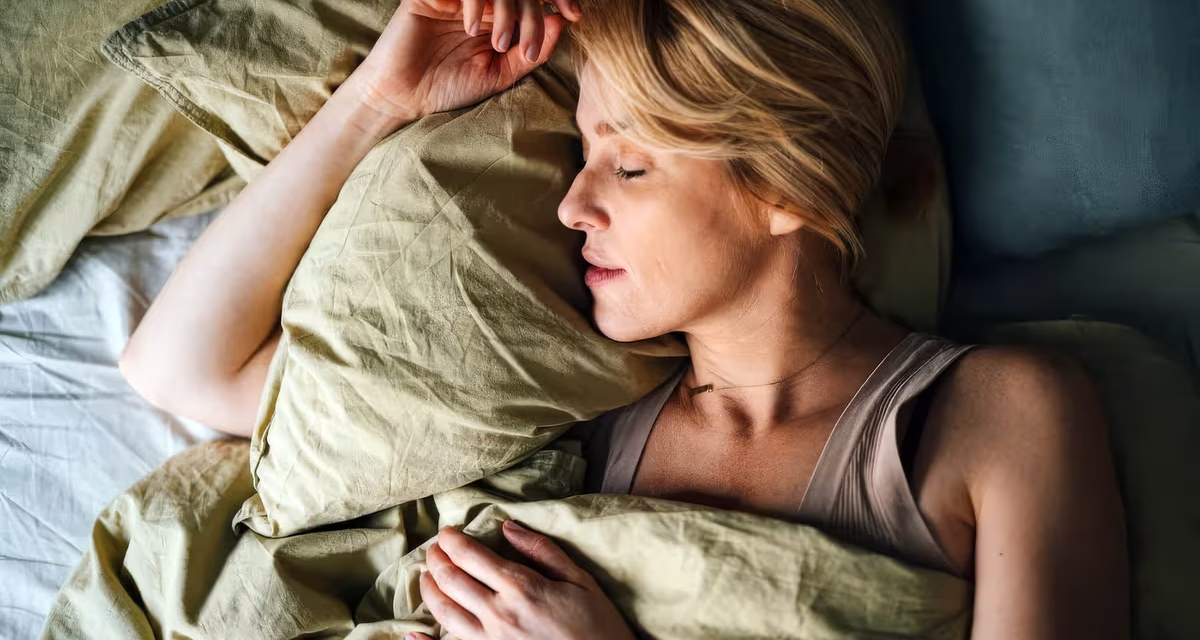

The number of hours a person sleeps was long thought to be regulated by the interactions of circadian clock and sleep homeostasis pathways, not by genetics.
Some people sleep less than everyone around them, wake up without an alarm, and feel fine all day. That pattern runs in families, and since 2019 a single changed letter in one gene has been the best-known explanation.
When researchers went looking for that letter in the general population, the people carrying it slept a perfectly ordinary seven hours.
Ying-Hui Fu and Louis Ptáček led the team at the UCSF Weill Institute for Neurosciences that reported it. Ptáček has long pushed back on the idea that everyone needs eight hours, which he once compared to “saying everybody in the population has to be 5 foot 10,” as he told Knowable Magazine.
They built that case on one family and on mice engineered to carry the same change. Neither one ultimately determines what the letter does in a stranger picked at random.
One family shared a rare mutation
Fu’s lab had already linked short sleep to a gene called DEC2 in a 2009 study, in a different family. The family in the 2019 paper had short sleepers across three generations, and not one of them carried the DEC2 change.
________________________________________________________________________
Read Also: Biodiversity in Urban Environments
________________________________________________________________________
Comparing those relatives turned up one rare difference, in a gene called ADRB1. The gene codes for a receptor protein, and in the mutated version a single building block had been swapped for another.
That receptor is better known outside the brain. Adrenaline lands on it in the heart and the heart beats faster, which is why beta-blockers, the drugs that shut the receptor down, get prescribed for heart trouble. Those same drugs are linked to trouble falling asleep and staying asleep.
In lab dishes, the mutated receptor broke down faster than the standard version and sent a weaker signal when it was triggered. In a large database of human gene sequences, it turned up about 4 times in every 100,000.
The lab’s bar for calling somebody a natural short sleeper is strict, a lifelong need for less than 6.5 hours a night.
Mice with the change slept less
The team wrote the same change into mice. Those mice slept about 55 minutes less a day than normal mice, and they lost that sleep during the dark hours, when mice are usually up and moving.
The receptor turned out to be unusually common in one patch of the brainstem, a region called the dorsal pons. Cells there were busy while the mice were awake and during REM sleep, and quiet during deep sleep.
So the team modified those cells to respond to light. Ten-second flashes during deep sleep woke the mice immediately, while the same flashes during REM sleep changed nothing.
In mice carrying the mutation, those same cells needed a smaller electrical current to fire, and the whole group of them was more active during the animals’ waking hours. Their proposal is that the mutation leaves the waking system easier to switch on, so sleep ends sooner.
Carriers in the population slept normally
Even inside that first family, one carrier didn’t fit. He slept seven and a half hours a night, an hour under the population average but nowhere near the lab’s cutoff. The researchers classed him as neither affected nor unaffected, and his daughter is a short sleeper.
A separate team tested that expectation in 191,929 people with both sleep records and gene sequences. The largest group came from UK Biobank, a British study following half a million adults.
Sixty-nine unrelated people in that group carried the ADRB1 change. They reported 7.1 hours of sleep a night, and everybody else reported 7.2. Meanwhile 23.2% of the carriers said they usually get six hours or less, compared to 23.7% of non-carriers.
That’s no difference at all. Not one of the 69 reported four hours or less, the range that made the original family unusual.
Fifteen carriers had also worn wrist trackers. They averaged 7.6 hours, a little more than the 7.3 hours of everyone else wearing one, and the shortest averaged 6 hours 53 minutes.
That team’s conclusion was that changes like this one often do very little when they show up by chance in a stranger.
The 2019 study never tested disease
Those experiments measured sleep, and that’s all they measured. The team never checked whether carriers escape what short sleep does to everybody else.
Short nights in the general population are linked to heart disease and to earlier markers of dementia, and none of that was measured in the carriers. Jet lag, mood, immune function, and multitasking were not tested either, though all four turn up in write-ups of natural short sleepers.
________________________________________________________________________
Read Also : Climate Change, Cost Factor: Why it Takes Months to Subdue Some Wildfires
________________________________________________________________________
Sleeping four to six hours on purpose is also a different thing from the inherited trait. The people in these families were born this way, and practice doesn’t move anyone else into their group.
Fu’s lab has kept the animal work going, crossing the mutant mice with mice bred to build up Alzheimer’s-like tau protein. The offspring got more REM sleep and built up less tau in a small wake-control cluster in the brainstem. That work is still entirely in mice.
Researchers keep finding sleep genes
Researchers reported DEC2 in 2009, ADRB1 and NPSR1 in 2019, GRM1 after that, and SIK3 in 2025. That’s five genes and counting, which is a different picture from one lucky gene.
For the SIK3 report, researchers recruited a healthy 70-year-old woman who told them she sleeps three hours a night. Wrist recordings put her closer to 6.3 hours.
Self-reported hours can be off by a lot, which is one reason that team checked wrist data as well as questionnaires.
No one has explained why one changed letter shortens sleep in a single family and does nothing measurable in 69 unrelated people who carry it.
Fu and Ptáček’s own answer, written into the 2019 paper, is the rest of a carrier’s DNA, whatever else somebody inherits deciding how much this one letter does. Nobody has identified those other pieces yet.
Finding those pieces means tracking down more carriers outside these families. It also means measuring their nights directly instead of asking about them, since researchers have relied on questionnaires and wrist movement rather than overnight sleep studies.
NOTE – This article was originally published in Earth and can be viewed here
Tags: #fitness, #getgreengetgrowing, #gngagritech, #greenstories, #health, #healthy, #immunefunction, #mood, #scientists, #sleep