

Carcinogenic chemicals, which get Indian agricultural exports rejected in Europe, continue to be sprayed at Indian farms without checks even though they are banned abroad. Why does the government allow these chemicals to find a place on Indian farms and then reach plates?
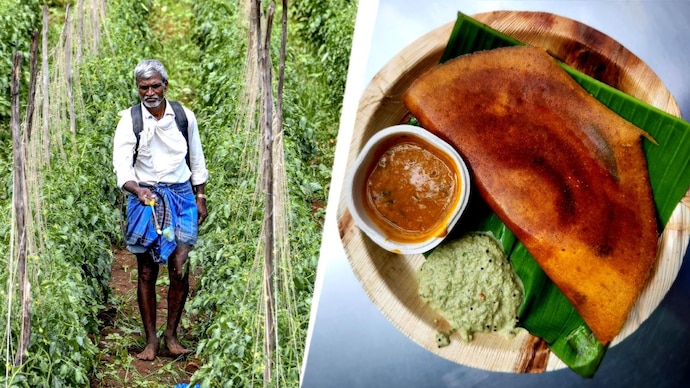
During the Vietnam War, American aircraft sprayed millions of litres of Agent Orange over forests and farmlands. They aimed to strip dense jungles of cover and destroy crops that could feed communist fighters. Now, more than half a century later, one of Agent Orange’s key ingredients, the herbicide 2,4-D, is still sprayed at Indian farms. The WHO’s cancer agency called it “possibly carcinogenic”.
It’s not 2,4-D alone. Another controversial herbicide, paraquat, is used in Indian fields despite being banned in more than 70 countries. Then there is glyphosate, a weedkiller classified as “probable carcinogen” by the WHO’s cancer agency. Then there’s dimethoate, which is banned in 31 countries over DNA damage concerns but sold in India. An insecticide, acephat, is linked to concerns over falling bee numbers.
Chemicals like these, which were once developed in Europe and the US, are used in Indian farms. They do not stop at farmland. Through food, these chemicals reach our plates, then, our bodies. But why is that being allowed? This would be an uncomfortable question for our policymakers and the government. Why are chemicals that have triggered health and environmental concerns abroad continuing to reach Indian farms and food chains?
The question has gained urgency after an analysis of European Commission and European Food Safety Authority data found that the EU’s 27 member states flagged and rejected 365 Indian products for pesticides and heavy metals between May 2024 and May 2026, according to a report in the Deccan Herald newspaper on June 6.
Indian agricultural products facing export rejections in India’s largest trading bloc, the EU, is a fact that offers little comfort. More concerning and discomforting is the safety of food consumed by millions of Indians. Some chemicals are considered too risky, restricted or heavily scrutinised elsewhere but sprayed indiscriminately on Indian fields.
The stakes are high for India, where cancer is already a public-health challenge. According to the Indian Council of Medical Research (ICMR), India recorded an estimated 14.6 lakh new cancer cases in 2022. The Centre said, the numbers would reach approximately 15.7 lakh in 2025. While cancer has multiple causes and no single pesticide can explain the rise, public-health experts say that exposure to substances classified as probable or possible carcinogens should be minimised wherever feasible and possible.
WHY IS PARAQUAT, BANNED ABROAD, LEGAL IN INDIA?
Few chemicals reveal what really is going on better than paraquat. It’s a herbicide that has been banned across much of the world over toxicity concerns, and continues to find a market in India.
The herbicide was first synthesised by Austrian chemist Hugo Weidel in 1882. Its weed-killing properties were discovered in the 1950s by Britain’s Imperial Chemical Industries (ICI), which later marketed it globally as Gramoxone. Over time, the product became associated with Swiss agrochemical giant Syngenta. It’s now owned by China’s ChemChina.
The European Union banned paraquat for agricultural use in 2007 over toxicity concerns. Today, at least 74 countries prohibit the herbicide, but it is legal in India.
Paraquat’s acute toxicity makes it controversial. Even small quantities can be fatal and there is no specific antidote for poisoning, according to biomedical papers. Researchers have linked its exposure to severe lung damage, kidney failure and an increased risk of Parkinson’s disease.
Farmer groups, including Rajasthan’s Kisan Mahapanchayat, have demanded tighter restrictions on paraquat. Some states, including Kerala and Telangana, have moved against herbicide. A petition seeking a nationwide ban remains before the Supreme Court, according to agriculture expert and Om Prakash, the Editor of Kisan Tak, India Today Digital’s sister portal on farming, the environment and climate.
GLYPHOSATE, THE HERBICIDE AT CENTRE OF GLOBAL FIGHT, IS LEGAL IN INDIA
Next in line is Glyphosate. It’s among the most widely used herbicides in the world, including India. The chemical was first synthesised by Swiss chemist Henri Martin before its weed-killing properties were commercialised by American agrochemical corporation Monsanto, which launched Roundup in 1974. The product went on to become one of the most successful agrochemicals in history.
In 2015, the International Agency for Research on Cancer (IARC), the WHO’s cancer agency, classified glyphosate as a “probable carcinogen” (Group 2A). The finding sparked a scientific and regulatory battle around the world that continues today.
While regulators such as the US Environmental Protection Agency and European food-safety authorities dispute the cancer link, Bayer, which acquired Monsanto in 2018, has paid billions of dollars to settle lawsuits alleging that Roundup exposure caused cancer. The company continues to deny the allegations.
Multinational and domestic companies in India producing glyphosate are reaping billions of dollars in profits year after year.
Despite the WHO’s IARC declaring it a probable carcinogen in 2015, Indian regulators are labelling it safe based on data provided by companies.
“This collusion between regulators and agrochemical companies is putting the health of millions of citizens at risk,” said Om Prakash of Kisan Tak.
WEEDKILLER FROM VIETNAM WAR-DAYS IS LEGAL IN INDIA
The story of 2,4-D began in the 1940s. As we discussed earlier in this article, the herbicide became one of the components of Agent Orange, the defoliant used by the United States during the Vietnam War. Today, it remains one of the most widely used weedkillers in the world, including in India.
In India, 2,4-D is widely used to control broadleaf weeds in crops such as wheat, paddy, maize and sugarcane. It’s one of the country’s most commonly applied herbicides.
In 2015, the IARC classified 2,4-D as “possibly carcinogenic to humans” (Group 2B). However, the IARC said there was limited evidence linking the herbicide to cancer in humans, while studies on laboratory animals and other experiments pointed to a potential cancer risk.
Unlike paraquat, 2,4-D has not been banned across the European Union and remains approved in several jurisdictions. However, health and environmental groups continue to push for tighter controls, citing concerns over long-term exposure to the chemical.
________________________________________________________________________
ACEPHATE AND THE FUTURE OF POLLINATORS
The use of acephate, an organophosphate insecticide used on cotton, vegetables, pulses and several other crops, presents a different case in the list of controversies around pesticides.
Unlike herbicides such as paraquat and glyphosate, concerns around acephate have centred less on cancer and more on its potential impact on pollinators and the wider environment. Pollinators are insects and animals, such as bees and butterflies, that help plants produce fruits, vegetables and seeds by transferring pollen between flowers.
Scientists and environmental groups have warned that exposure to acephate and its breakdown products can harm honey bees and other beneficial insects that play a crucial role in pollinating crops and maintaining several ecosystems.
The concern is real because pollinators are essential to global food production. A decline in bee populations can affect the productivity of fruits, vegetables, oilseeds and several other crops that depend on insect pollination.
India has reviewed acephate as part of broader efforts to examine potentially hazardous pesticides. However, the insecticide is registered for use and is widely used by farmers to control pests such as aphids, jassids, thrips and whiteflies.
While acephate has been an effective and affordable tool for protecting crops, the continued dependence on these older pesticides has also delayed the adoption of safer alternatives, while already posing risks to biodiversity.
WHY ARE HARMFUL CHEMICALS STILL USED IN INDIAN AGRICULTURE?
The backers of the chemicals and the fertiliser lobby might argue that modern agriculture cannot function effectively without chemically produced pesticides and herbicides. They even warn that banning them could hurt farmers, disrupt their practices, reduce yields and increase costs.
But there’s a different picture on the other side of the debating table. Chemicals developed and commercialised in Europe and the West, for which Indian products are facing restrictions, legal challenges or health warnings, still find large markets in developing countries such as India. And the critics say that is a matter of concern.
Ultimately, this is a debate about how Indian regulators should weigh scientific facts, public health concerns and farmers’ needs, and what level of risk our society is prepared to live with. Europe has tightened food-safety standards and repeatedly flagged contaminated imports from India that are contaminated with these chemicals.
Policymakers must decide whether India should continue relying on these chemicals or chart a shift towards a precautionary approach. The transition, if it comes, must be scientific, phased and practical. And there’s a question for our policymakers. Should an Indian life be valued any less than another elsewhere? The answer is an obvious “no”.


![[Funding alert] Agritech startup Gramophone raises Rs 24 Cr in Series A from Info Edge, Asha Impact and Better Capital](https://greenstories.co.in/wp-content/themes/Extra/images/post-format-thumb-text.svg)


