Wchat began as a risky bet in one of China’s harshest landscapes has turned into a showcase for desert agriculture.

Far from China’s traditional tropical plantations, researchers have turned to the Gobi Desert as a testing ground for a new kind of strategic crop: high-value rubber-producing trees.
The effort reflects Beijing’s push to reduce its exposure to fragile overseas supply chains, as China remains the world’s largest consumer and importer of natural rubber, driven largely by its vast automotive and industrial sectors. Last year, national demand is estimated to have topped 7 million tonnes, with more than 85 per cent coming from abroad.
That vulnerability is why scientists are focusing on Duzhong, or Eucommia ulmoides. Long prized for its bark in traditional Chinese medicine, the hardy tree is also China’s only native source of natural rubber and the world’s second-largest rubber resource.
Key ingredient in China’s next-gen defence systems
Rubber derived from Duzhong has proven especially valuable for defence applications: adding just 3 to 5 per cent to a rubber compound significantly boosts durability and wear resistance in high-performance, puncture-resistant tyres, while the material is also used in advanced electromagnetic shielding composites.
Until recently, Duzhong was grown mainly in central and southern China, especially across the Yangtze Plain. Production remained constrained by modest yields and a difficult, labour-intensive extraction process, limiting its role in large-scale industrial and military supply chains, the South China Morning Post writes.
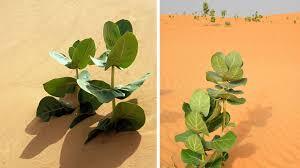
What began as a risky bet in one of China’s harshest landscapes has turned into a showcase for desert agriculture. In 2016, a team led by Su Yinquan, dean of forestry at Northwest A&F University, leased 14 hectares of barren Gobi land in Xinjiang to test whether Duzhong could survive and grow there. It was the first time the medicinal rubber tree had been planted in the region.
By last year, the former wasteland had been transformed into a dense, productive Duzhong forest. The results have exceeded expectations. Zhu Mingqiang, a Northwest A&F professor who worked on the project from the start, said earlier this month that the Duzhong industry is flourishing. China now grows Duzhong on about 300,000 hectares, with plans to expand to 3.3 million hectares by 2030, including another 300,000 hectares in Xinjiang alone.
Engineering a desert-ready rubber tree
Turning a medicinal tree into a reliable desert crop required more than just planting it in the sand. The first major hurdle was genetics and to solve it, the research team built a dedicated breeding base in Lueyang county in Shaanxi, where Northwest A&F University is based.
Using key indicators for medicinal value and rubber yield, scientists screened more than 50 elite Duzhong germplasms from across China and ran a systematic breeding programme, ultimately producing strains adapted to arid, desert conditions.
The second challenge was boosting rubber output. Under China’s 2016–2030 National Duzhong Industry Development Plan, the fruit peel, bark and leaves contain 15 to 18 per cent, 8 to 10 per cent, and 2 to 3 per cent natural rubber respectively, making full-plant extraction central to the project’s economics.
In November, Zhu announced a breakthrough: a “rubber priority” extraction process published in ACS Sustainable Chemistry & Engineering. The method combines low-melting-point, eco-friendly solvents with biological treatment for initial gum separation, followed by targeted steps to isolate the rubber. The result is a faster, greener process that significantly lowers energy and solvent consumption while delivering high yields and exceptional purity, making large-scale Duzhong rubber production more practical and sustainable.
NOTE – This article was originally published in Interesting Engineering and can be viewed here