
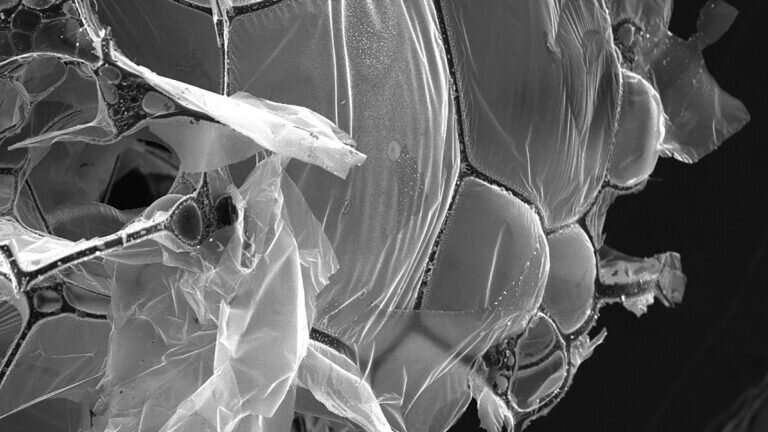
Researchers at Princeton Engineering have found a way to turn your breakfast food into a new material that can cheaply remove salt and microplastics from seawater.
The researchers used egg whites to create an aerogel, a lightweight and porous material that can be used in many types of applications, including water filtration, energy storage, and sound and thermal insulation. Craig Arnold, the Susan Dod Brown Professor of Mechanical and Aerospace Engineering and vice dean of innovation at Princeton, works with his lab to create new materials, including aerogels, for engineering applications.
_______________________________________________________________________
Read Also : Nuclear tests in 1960s may have contributed to climate change
________________________________________________________________________
One day, sitting in a faculty meeting, he had an idea.
“I was sitting there, staring at the bread in my sandwich,” said Arnold. “And I thought to myself, this is exactly the kind of structure that we need.” So he asked his lab group to make different bread recipes mixed with carbon to see if they could recreate the aerogel structure he was looking for. None of them worked quite right initially, so the team kept eliminating ingredients as they tested, until eventually only egg whites remained.
“We started with a more complex system,” Arnold said, “and we just kept reducing, reducing, reducing, until we got down to the core of what it was. It was the proteins in the egg whites that were leading to the structures that we needed.”
Egg whites are a complex system of almost pure protein that—when freeze-dried and heated to 900 degrees Celsius in an environment without oxygen—create a structure of interconnected strands of carbon fibers and sheets of graphene. In a paper published Aug. 24 in Materials Today, Arnold and his coauthors showed that the resulting material can remove salt and microplastics from seawater with 98% and 99% efficiency, respectively.
________________________________________________________________________
Read Also : Life Cycle Assessment (LCA) to Examin Environmental Implications
________________________________________________________________________
“The egg whites even worked if they were fried on the stove first, or whipped,” said Sehmus Ozden, first author on the paper. Ozden is a former postdoctoral research associate at the Princeton Center for Complex Materials and now a scientist at Aramco Research Center. While regular store-bought egg whites were used in initial tests, Ozden said, other similar commercially available proteins produced the same results.
“Eggs are cool because we can all connect to them and they are easy to get, but you want to be careful about competing against the food cycle,” said Arnold. Because other proteins also worked, the material can potentially be produced in large quantities relatively cheaply and without impacting the food supply. One next step for the researchers, Ozden noted, is refining the fabrication process so it can be used in water purification on a larger scale.
If this challenge can be solved, the material has significant benefits because it is inexpensive to produce, energy-efficient to use and highly effective. “Activated carbon is one of the cheapest materials used for water purification. We compared our results with activated carbon, and it’s much better,” said Ozden. Compared with reverse osmosis, which requires significant energy input and excess water for operation, this filtration process requires only gravity to operate and wastes no water.
While Arnold sees water purity as a “major grand challenge,” that is not the only potential application for this material. He is also exploring other uses related to energy storage and insulation.
_______________________________________________________________________
Read Also :Environmental Technology: What Is It and How Can It Help Us?
________________________________________________________________________
The research included contributions from the departments of chemical and biological engineering and geosciences at Princeton and elsewhere. “It’s one thing to make something in the lab,” said Arnold, “and it’s another thing to understand why and how.” Collaborators who helped answer the why and how questions included professors Rodney Priestley and A. James Link from chemical and biological engineering, who helped identify the transformation mechanism of the egg white proteins at the molecular level. Princeton colleagues in geosciences assisted with measurements of water filtration.
Susanna Monti of the Institute for Chemistry of Organometallic Compounds and Valentina Tozzi from Instituto Nanoscienze and NEST-Scuola Normale Superiore created the theoretical simulations that revealed the transformation of egg white proteins into the aerogel.
NOTE – This article was originally published in phys and can be viewed here
Tags: #breakfast, #carbon, #eggs, #environment, #getgreengetgrowing, #gngagritech, #greenstories, #microplastics, #seawater, #water





Great ?V I should certainly pronounce, impressed with your site. I had no trouble navigating through all tabs and related information ended up being truly easy to do to access. I recently found what I hoped for before you know it in the least. Quite unusual. Is likely to appreciate it for those who add forums or anything, website theme . a tones way for your customer to communicate. Nice task..
Very interesting information!Perfect just what I was searching for!
Thank You for your feedback