An artistic reconstruction of Earth during the Hadean eon (~4.5 billion years ago). Intense volcanic activity, heat from accretion, and frequent impacts kept the young Earth in a molten state. This fiery landscape set the stage for the earliest formation of the crust and the eventual emergence of stable continents. Credit: Science China Press
Researchers used zircons and AI to reconstruct Earth’s ancient crust, revealing possible tectonic processes from the planet’s earliest, rockless chapter.
Researchers from the School of Earth Sciences at Zhejiang University, led by Professors Jia Liu and Qunke Xia, have made a significant breakthrough in exploring a long-lost chapter of Earth’s geological past. Their work, carried out by PhD students Denggang Lu, Zhikang Luan, Jingjun Zhou, and Tianting Lei, offers new insight into what the planet’s continental crust may have looked like during the Hadean eon. This ancient period, which began approximately 4.4 billion years ago, marks the earliest known era in Earth’s history.
_______________________________________________________________________
Read Also : THE TRASH MOUNTAINS BEING TURNED INTO SUSTAINABLE FASHION IN RUSSIA
________________________________________________________________________
“The Hadean is a key period for understanding the origin of Earth’s continents,” said Prof. Jia Liu. “But rocks from this time are incredibly rare. So far, the only known samples are from the Acasta region in Canada and date to about 4.03 billion years ago.” Due to intense geological activity in Earth’s early days, most rocks from that time have been destroyed, leaving behind what scientists call a “missing chapter” in Earth’s story.
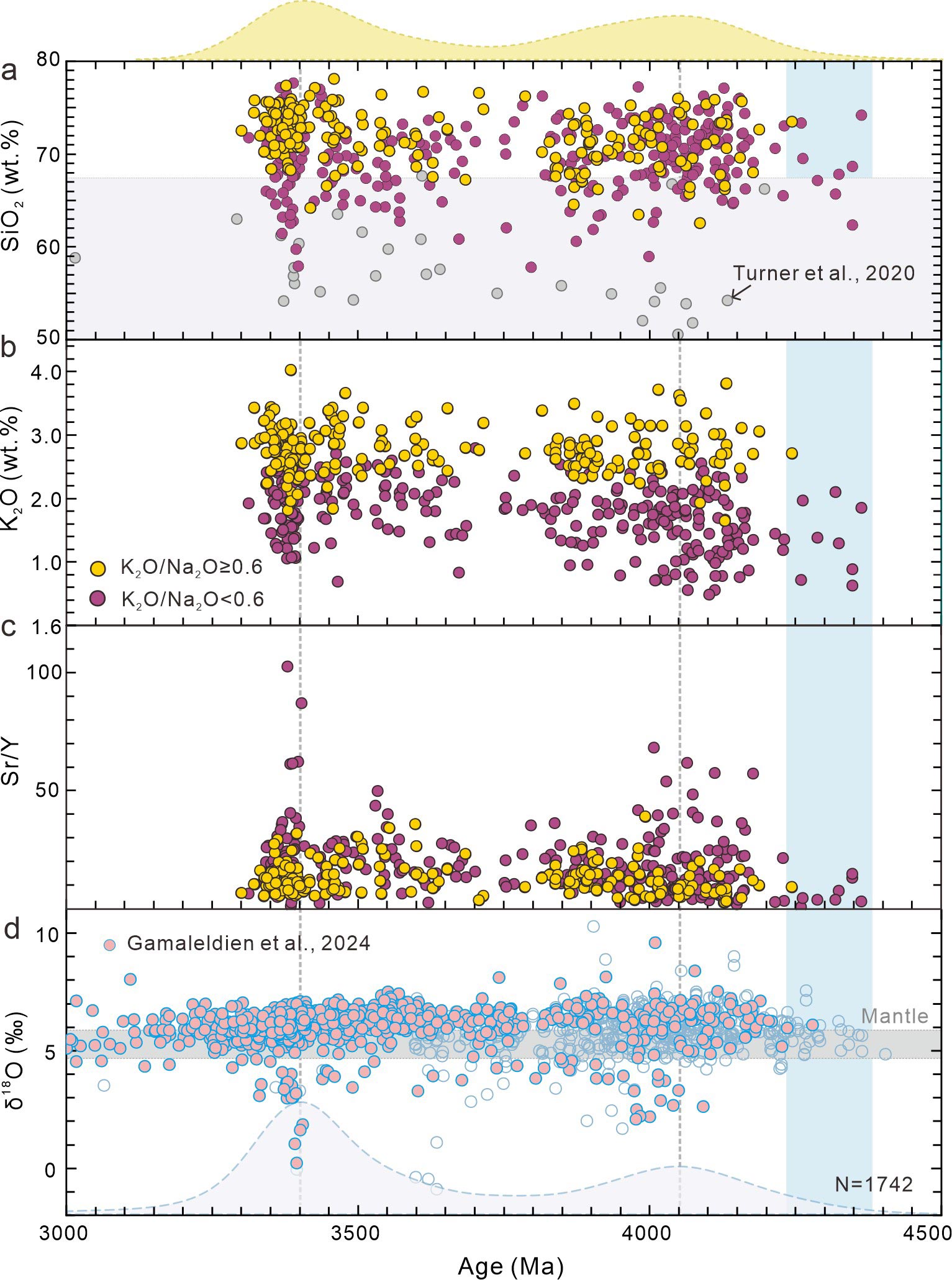
Although direct rock samples from this time are almost nonexistent, a remarkably tough mineral called zircon has managed to preserve valuable clues. Some zircon crystals date back more than 4.3 billion years and have been discovered in regions such as the Jack Hills in Australia. These tiny crystals hold geochemical signatures that reveal details about magma activity on the early Earth.
_______________________________________________________________________
Read Also : Impending extreme summers 2021 – climate change
________________________________________________________________________
“We don’t know what the actual rocks of the Hadean crust looked like, because we don’t have any—but zircons give us a window into that hidden world,” said PhD student Denggang Lu.
Reconstructing Lost Crust Through AI
To unlock that window, the team compiled the world’s most comprehensive geochemical database to date of igneous zircon and their host rocks—more than 14,000 zircons and 823 matched rock records. Using this database, they trained supervised here