
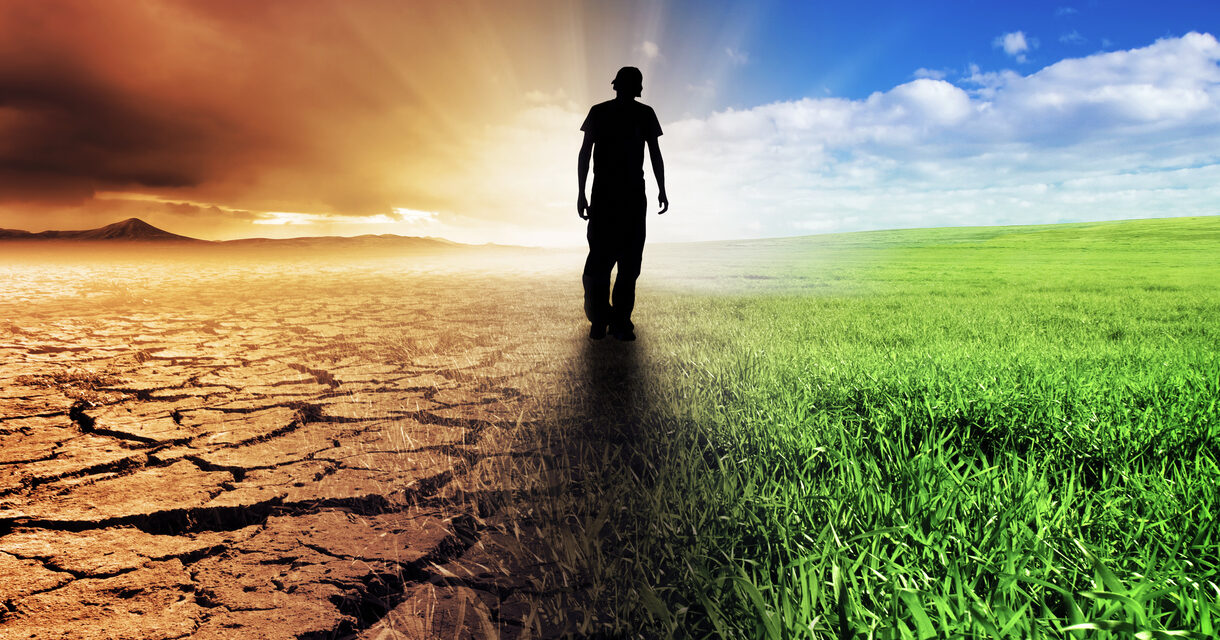
A Climate Change Concept Image
Pic courtesy – https://public-health.uq.edu.au/article/2021/04/urgent-need-safeguard-mental-health-climate-change
In the evening I came back from the office around five-thirty. With a cup of tea, I switched on the TV to know about today’s news highlights. The first one was nine people killed in Chicago in a shootout. An intense fight between the army and terrorists in Jammu & Kashmir is a regular affair. Seventeen years old girl on her way to school stabbed by a stalker now battles for life. Two were arrested for killing a man in east Delhi in a case of road rage. Three workers of a political party were shot, throats slit; the party points fingers at the other party. Some religious outfit has threatened the spokesperson of other religion. Then there was a provocative and argumentative discussion of some modern intellectual panelists on the channel. It was emanating strong waves of disrespect to every other person. The situation is as if everybody is sitting in a boiling pot. Grievances, dissatisfactions, allegations, and insensitivity is prevalent in the environment. Something is wrong with the environment we are living in.
________________________________________________________________________
Read Also : Population and pollution – How they are interrelated?
________________________________________________________________________
To date, there are no deep studies on global warming and human behavior. But certainly, there’s a direct link between them. Today’s environment is human’s creation, where human is bent on killing a fellow human. Climate is one of the most critical parts of the environment. Climate change and human behavior map out how hotter temperatures and more frequent severe weather conditions can, directly and indirectly, alter the way people think and interact with others. There’s an optimum temperature at which the brain and body work best. High temperatures cause the brain to divert resources to other parts of the body to cool down. When this happens, areas of the brain are not running at full capacity making it harder to process the new information, manage emotions, and control impulses. Most recently researchers have shown an association between extreme heat waves and worsening symptoms of mood, anxiety disorders, schizophrenia, and even suicide risks.
There are just some of the ways, we know climate change can cause harm to our brains. Our brains are very adaptable and can hide or mask the harm done, for many years. Most often by the time patients seek neurologist’s help, more than 50% of the total nerve cells already died and the disease is at an irreversible stage. There’s a clear correlation between heat and worsening symptoms of MS (multiple sclerosis). What is worse is, that the dynamic developing brains of children and adolescents are the ones that are the most susceptible to the adverse effects of climate change, which results in lower IQ, poorer ability to do tasks that require hand-eye coordination, and neural developmental disorders in children and teens. For each 1-degree Celsius increase in mean temperature above a threshold of 18 degrees Celsius, there’s a 3.8% increase in suicide. During heat waves, there is a 13% increase in assault-related injuries among people 15-64 years of age.
________________________________________________________________________
Read Also : TURBULENCES ARE MUCH BEYOND RECURRING EARTHQUAKES & PANDEMICS
________________________________________________________________________
Wildfires, cyclones, floods, and droughts are more frequent and it is now the new normal. These shocks not only damage the environment rather weaken our political, economic, and social systems. Because of the prolonged war situation in Afghanistan, reduced harvests have pushed people into poverty, leaving them susceptible to recruitment by rogue armed groups. In some pacific small islands nation’s entire communities have been forced to relocate. Climate change may render certain parts of the world uninhabitable due to drought, rising temperatures, and other extreme conditions. Human survival in a situation of resource degradation, hunger, poverty, and uncontrolled climate migration will make conflict a reality and an inevitable outcome. As nations struggle to cope with catastrophic weather conditions, diminishing resources and environmental degradation, population dislocation and various other climate-induced problems can disturb and disrupt the very fabric of any society or a country. It is ideal rather than a tailor-made situation for the violent persecution of vulnerable refugees, and religious and ethnic minorities.
As the climate crisis causes more extreme and frequent droughts, wildfires, floods, and hurricanes, people around the world will be at higher risk of hunger and malnutrition, and economic and social instability. This can drive mass migration to areas with more resources. These conditions have contributed to the development of the civil war in Syria. It began in 2011 and caused an estimated four lakhs deaths, forcing more than one crore Syrians to flee their homes. From 2006 to 2009, drought transformed approximately 60% of the land area into a desert. Eighty percent of the cattle died. As many as 15 lakh people abandoned their farms and moved to cities that were already burdened with more than one crore Iraqi refugees. By the end of 2010, the Syrian urban population was 13.8 million, which was approximately 50% more than it had been in 2002.
Analytical frameworks can help us to understand various interactive environmental factors associated with climate change that can contribute to collective violence. The scarcity of environmental resources primarily cropland, forests, river water, and fish can lead to severe social stress. Consequently, it leads to urban unrest, clashes among cultural and ethnic groups, and finally leads to terrorism. In Ethiopia, biomass fuel contributes to the scarcity of the very environmental resource. A little more research to determine and demonstrate the benefits of promoting renewable energy in rural areas and low-income group countries, which can enhance lighting for childhood education, biofuels for women in their kitchen, improved cold storage facility for food and medicines and decreased indoor air pollution from cooking will reduce the risk of collective violence.
________________________________________________________________________
Also Read : Immune System and its link with Eating Healthy and Organic Food
________________________________________________________________________
By 2100, the sea level is likely to rise by 20 to 55 inches above the 1990 level. Some studies suggest that by 2100, it could be 1.83 meters or six feet given, but only Antarctica could contribute more than one meter or 3.3 feet. Twenty percent of the world’s population lives in coastal areas. The situation may force people to become internally displaced within their own countries or refugees in neighboring countries. Sea rise will damage cropland and create saltwater incursion into river deltas, and groundwater aquifers and cause a shortage of food and fresh water. As a result, there will be major political, economic, and social disruptions associated with violence. We are seeing it in Sri Lanka reasons are different but nature is similar. Climate change or more precisely GLOBAL CLIMATE DISRUPTION is profoundly affecting life on Earth in many interrelated ways.
Climate change is fundamentally a development issue. We have to keep the economy growing. There can’t be turning back. But this is also the fact that the condition of our planet and happenings all around call up for deep introspection. Artificial civilization appears to be dominant everywhere leaving a major part of the world population deprived of access to life-sustaining resources. Virtual reality is the real reality where sensitivity has no place. The world must move from 51 billion metric tons of greenhouse gas emissions each year to net zero. Only then the increase in global temperature remains within manageable levels. It is humans and not money that must be placed at the Center of the priority of the issues. We must avoid becoming the victim of SPLURGE SYNDROME. What we have to do is to decouple growth from carbon emissions.
Tags: #climate, #climatechange, #climatecrisis, #climaterisk, #cyclones, #earth, #environment, #floods, #getgreengetgrowing, #globalwarming, #gngagritech, #greenstories, #life, #nature, #schizophrenia, #wildfires






Watch the international online conference
GLOBAL CRISIS. WE ARE PEOPLE. WE WANT TO LIVE. People from 180 countries are already raising this issue. And they’re talking about a way out of the climate crisis. It’s important that everyone is involved.