New insects, birds and reptiles continue to be found on the island, some found nowhere else. The destruction of forests could mean their doom, scientists say.
When Pia Sethi accompanied her friend Nitu Sethi to Great Nicobar this summer, she was hoping to get a glimpse of some of the island’s rare and endemic bird species. Nitu, an avid birdwatcher, maintained what is referred to as a “life list”, of all the species that a birder sees in their lifetime. The two hoped to add some names to Nitu’s list on their trip.
What they were not expecting was to chance upon a bird new to science.
On a May evening, Pia and Nitu were in a forest in Campbell Bay, looking for the slaty-legged crake, an orange-headed bird with black and white stripes on its belly. Suddenly, they heard a bird call that they could not identify – they did not manage to find the source of the call.
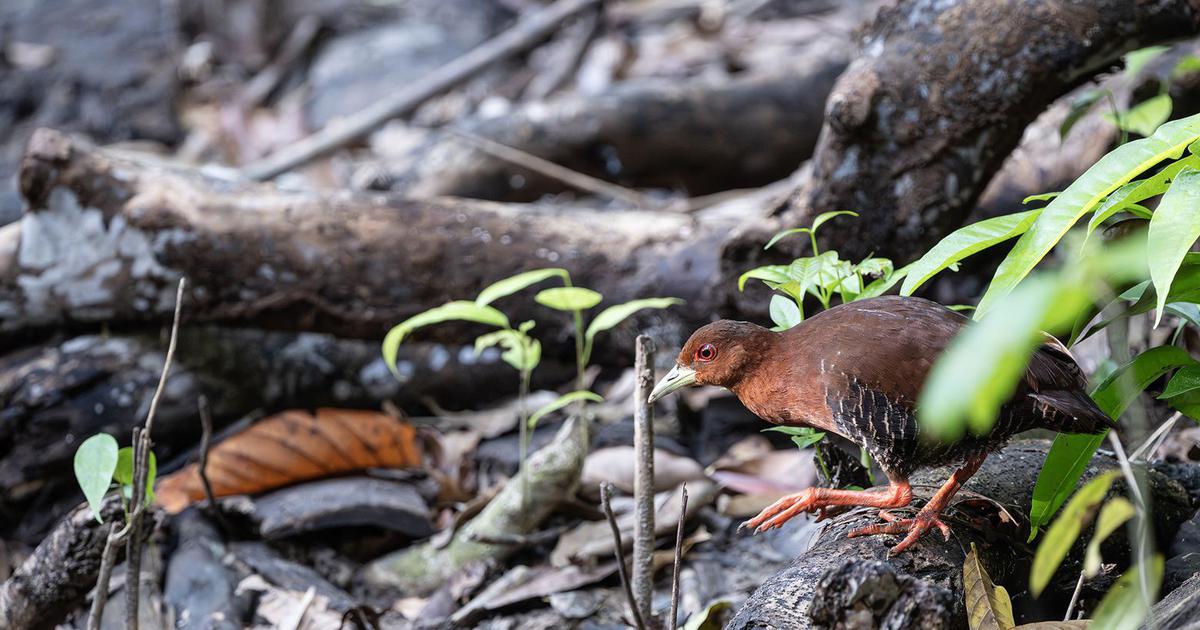
Pia, who is an ecologist and a senior fellow at the Centre for Ecology Development and Research, in Dehradun, remembered that she had read about the possibility that the island housed another species of crake, as yet unconfirmed. Excited by the prospect of spotting it, the duo along with Vikram Shill, a bird tour guide from Port Blair, returned to the site the next morning. As they walked around, they saw a bird cross the road and disappear into vegetation. It was not a slaty-legged crake; it had far less distinct black and white stripes on its underbelly. Further, while the slaty-legged crake has a dark beak and grey legs, this bird had a pale green beak and orange-red legs.
________________________________________________________________________
Pia took quick photographs of the bird, while others captured the first-ever recording of its call. Later, the three analysed the call and the bird’s physical characteristics, and confirmed in a paper they jointly authored that it was likely to be a new species – it is colloquially being called the Nicobar crake, and has yet to be given an official name.
“In areas like Great Nicobar, you never neglect things like unrecognised calls, because you never know what you might see, since the islands are so under-surveyed,” Pia told Scroll.
Their discovery was not an unusual occurrence – apart from this bird, nearly 40 new species have been reported from the island in the last four years, including flies, beetles, frogs and a snake.
But a shadow looms over such discoveries: the crake and the new species of snake were found in Galathea Bay, where the Indian government plans to build an international transshipment port, as well as in Gandhi Nagar and Govind Nagar, which are sites of a new airport proposed on the island. This infrastructure is part of the Rs 92,000-crore Holistic Development of Great Nicobar Island project, which also includes a new township and a power plant. Nearly 10 million trees of ancient rainforests will be cut for the project, which will occupy almost 20% of the island.
Ecologists and activists fear that the project will spell doom for a range of flora and fauna on the island, much of which has not even been identified. “The fact that you are finding these new species just shows that we have not even scratched the surface of the different types of species found in Great Nicobar,” Pia said. The upcoming project worried her immensely, especially since “these sightings have happened exactly where it is coming up”, she said.
Why species are unique in the islands
Of the over 8,000 species of fauna that have been recorded on the Andaman and Nicobar Islands, around 1,100 are listed as endemic by the Zoological Survey of India – that is, they do not occur naturally anywhere else in the world. Specifically, 33% of birds, 50% of reptiles and 24% of the insects found on the islands are endemic to them.
Biologists note that the islands have a high level of endemism because they have long been geographically isolated from the main landmasses.
Islands in the two groups also have species that are distinct from each other because they formed from different geographic landmasses – the Andaman’s northern islands were joined with the landmass of Myanmar, while its southern islands and the Nicobar islands were joined with the Sumatra landmass.
“Migration and dispersal abilities of wildlife have been influential in the species structure of these islands,” said Zeeshan Mirza, a biologist with the Max Planck Institute for Biology in Germany. When these islands were connected to their respective landmasses, he explained, it is possible, for instance, that a mammal would have walked up to a certain point and established itself, but that subsequently, sea levels rose to form an island, thus preventing it from dispersing further.
Biologists involved in the discoveries of the new crake and the snake, known as Irwin’s wolf snake, suggest that based on the limited data, these new species too, are likely endemic to the island.
Mirza, who was a co-author of the paper that officially recorded the new snake species, added that he was “100% sure” that there are more species to be discovered on the islands. In both groups of islands, he added, “We have seen photos of snakes from the place and not been able to immediately recognise the species.”
“Description” of species
Once a species is discovered, it needs to go through a rigorous process of “description” – it is only after this that it is recognised globally as a species.
Typically, for this process, scientists deposit at least one specimen in a museum or a laboratory. Researchers study this specimen closely, documenting its physical attributes in detail, and making comparisons with other closely related species. “This ensures that what you are describing is something new, along with strong evidence,” said Harikrishnan S, manager of the Amphibian Recovery Project with Wildlife Trust of India, who worked on the reptiles and amphibians of Andaman and Nicobar Islands between 2008 and 2014.
After this process, those overseeing the study usually publish their findings in a peer-reviewed publication and suggest a name for it.
________________________________________________________________________
In the case of the Nicobar crake, the recent paper provides details about how and where it was discovered, and some of its physical attributes – but the species is yet to be fully described, a process that would entail further research and the collection of samples such as feathers, through which its genetic material can be analysed. For now, it is listed as “undescribed”.
But Pia noted that this process might need time, since the bird is known to be “shy” and is hard to find – meanwhile, the infrastructure project is rolling steadily forward. “Are we losing the bird without it being ever described to science?” she said.
Time for identification
Biologists noted that to identify new species, it was essential that an ecosystem be left undisturbed over time – since correct identification is often a long process that can begin with misidentification.
For instance, while Irwin’s wolf snake was formally listed as a new species this year, it was first documented more than a decade ago, in 2010. At that time, however, the available morphological information of the snake’s physical attributes, like its color and shape, suggested that it was similar to the Malay wolf snake found across south-east Asia. “Because of increasing interest in taxonomy, scientists started looking at it in greater detail, and started realising that these are different species,” said Harikrishnan, who was part of the team that first discovered the snake on the island in 2010.
Later, a team that included Mirza re-examined the specimen of the snake collected by Harikrishnan, as well as a new specimen, and conducted molecular comparisons with other closely related snake species. Their study found that the snake had a “distinct lineage”, and the biologists went ahead to describe and gave it the scientific name Lycodon irwini, after the Australian conservationist Steve Irwin.
“This is only possible because we are accumulating and gaining more information about the snake,” said Harikrishnan.
The discovery of the Nicobar crake also had a similar trajectory. It was first found on Great Nicobar in 2012. At first, scientists reasoned that it might be a distinct species – but after the red legged and slaty-legged crake were discovered in subsequent years, scientists speculated that the other bird might be a hybrid between the two species.
It was only 13 years later that Pia and her team analysed the bird’s characteristics and concluded that there was a likelihood that it was a new species. Among the evidence that the team assessed was the bird’s physical attributes – they found that in the few sightings of the bird over a decade, its physical traits had remained consistent. This, they noted, meant that it was unlikely that it was a hybrid, since hybrids typically display less consistent characteristics.
Pia’s team’s analysis of the bird’s call also contributed to the conclusion. “Even though it is fairly similar sounding to the red-legged crake found on the island, the Nicobar crake was more halting, had fewer notes per phrase, and more gaps between phrases,” said Pia.
Mirza argued that to allow for such discoveries, even if the infrastructure project went through, it was vital that some areas be left untouched for wildlife to thrive. This could help avoid a “complete wipeout” of the island’s species, he noted. But even to identify these important areas, he said, “there needs to be more research”.
“It’s much easier to wipe out a forest when there is nothing recorded in the forest,” said Mirza.
NOTE – This article was originally published in Scroll and can be viewed here