- Bangladesh is becoming a major destination for global e-waste due to rising imports and weak regulation of imported electronic products.
- In addition, illegal imports and misdeclared shipments have made Bangladesh a net importer of e-waste.
- Most e-waste is handled by informal workers without protection or awareness of health risks.
- Without strong enforcement of law, the country risks becoming a long-term dumping ground for toxic electronic waste.
As the world turns its attention to China’s increasingly stringent waste import ban, a dangerous stream of electronic waste is entering Bangladesh.
Despite the enactment of the Hazardous Waste (e-waste) Management Rules 2021, weak regulatory systems and illegal trade routes are making the country a major destination for global “e-waste.”
Electronic waste (e-waste), which includes discarded computers, laptops, phones, refrigerators and medical equipment, has become a growing crisis.
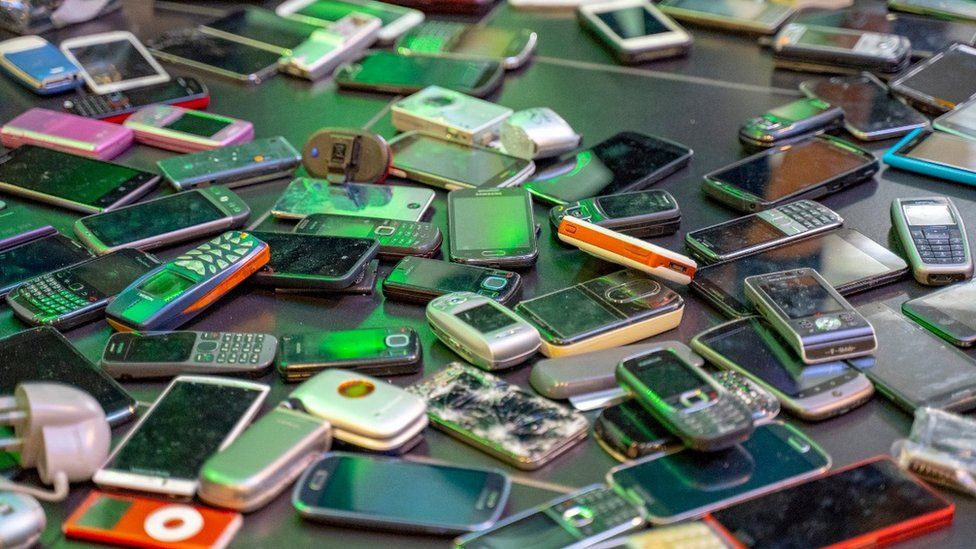
According to the Bangladesh Mobile Phone Importers Association, about 35 million mobile handsets are sold every year in Bangladesh. With an average lifespan of just 2-4 years, about 30 million devices enter the local waste stream every year, most of which go unmonitored.
The crisis is exacerbated by a massive increase in electronics imports.
Bangladesh Bank (BB) data show that more than $2.47 billion was spent on imports of electrical appliances and accessories in the 2024-25 fiscal year. A significant portion of this was coming from China worth $1.8 billion.
However, experts warn that a growing black market in refurbished products is hiding the true extent of the environmental threat.

Escalating electronics imports and the e-waste shadow
The influx of electronics into Bangladesh has reached staggering proportions, raising significant concerns over the nation’s potential role as an unwritten “dumping ground” for global waste.
A latest Transparency International Bangladesh (TIB) study, using import and export data from the customs department, has revealed that Bangladesh imported e-waste materials worth around $700,000 over the past three years (2022-24), since the enactment of e-waste management rules.
The study found that an estimated 14,985 tons of e-waste were imported illegally during this period, far exceeding the country’s export of e-waste components, which stood at 4,040 metric tons of printed circuit boards and scrap. This imbalance effectively makes Bangladesh a net importer of e-waste.
However, the study report cautions that the figure is likely an underestimation, as there may be instances of misdeclaration, masking the true scale of inflows.

Regional and global trade figures further illustrate this mounting volume
In the final quarter of 2025, imports from India included electrical machinery. The United States supplied $18.8 million in optical and medical devices, up from $16.3 million during July to September 2025, while its electrical machinery exports fell to $7.7 million. Japan’s optical and medical device shipments also declined, from $9.6 million during July to September 2025 to $7.0 million in October-December 2025 quarter, according to BB data.
________________________________________________________________________
The U.N. COMTRADE database previously valued Bangladesh’s electrical and electronic equipment imports at $5.8 billion in 2018. With these figures continuing to evolve as of April 2026, the persistent arrival of complex machinery and parts underscores an escalating environmental challenge for the country’s waste management infrastructure.
Abdullah Zahid Osmani, TIB research associate on environment and climate finance, said, “Some importers are also using false declarations by labeling shipments as spare parts, while in reality importing obsolete or end-of-life machinery, particularly from countries such as China and Hong Kong.”
Osmani, who led the study, said such practices are in clear violation of both the Basel Convention on hazardous waste and national regulations.
He pointed to a persistent coordination gap among relevant agencies, saying enforcement remains weak due to overlapping responsibilities and limited institutional focus.
He further said customs officials often remain unaware that such imports are restricted under the existing e-waste regulations.
“The Department of Environment (DoE), the custodian of e-waste management rules, are busy dealing with air pollution, brick kiln and other issues, so e-waste monitoring and regulation are not getting adequate attention,” he said.
The department should work in close coordination with the Office of the Chief Controller of Imports and Exports and the customs authorities to ensure effective e-waste management and develop a clear regulatory strategy, Osmani suggested.

Bangladesh turning into dumping ground for e-waste
Dr. Shahriar Hossain, senior technical adviser, Environment and Social Development Organization-ESDO, has warned that Bangladesh is increasingly turning into a dumping ground for electronic and electrical waste, largely driven by imports from China.
He said, “Around 80-90% of electrical and electronic goods entering the country originate from China, with a significant share consisting of refurbished laptops, mobile phones and spare parts.”
“Many of these products — particularly smartphones such as iPhones, Samsung and Xiaomi devices, along with laptops and LCD screens — are rejected during quality checks or returned under warranty, then repaired, repackaged and exported as low-cost alternatives. A large volume enters Bangladesh through informal channels, including so-called ‘luggage parties,’” he stated.
Hossain pointed out that nearly 90% of laptops in the local market are refurbished and have a short lifespan, quickly turning into waste. “We need not only stricter enforcement of rules but also clear management guidelines, along with a polluters-pay principle,” he said.
While most e-waste comes from China, smaller volumes also arrive from countries like the U.S., India and Japan, he noted.
Hossain also noted domestic sources, citing “about 4 million battery-run rickshaws and over 4.15 million motorcycles generate hazardous battery waste, often discarded indiscriminately, posing risks to soil, water and public health.”

Policy vacuum: Rules on paper
According to the TIB study, the E-Waste Management Rules of 2021 currently exists more as an official formality than a viable law.
The TIB research has found that the DoE has failed to create any coherent path for the informal scrap sector. Although the sector has been active for decades and many traders have licenses, they remain outside environmental monitoring.
In addition, due to lack of coordination between the Department of Environment and Bangladesh Telecommunication Regulatory Commission, registered recyclers are trapped in bureaucratic complexities, which are being exploited by unregulated waste traders.
Md. Ziaul Haque, DoE additional director-general, said, “We could not progress much after the rule was enacted in 2021. However, listing of importers, manufacturers and e-waste recyclers has been done.”
Under the Bangladesh Environmental Sustainability and Transformation (BEST) Project supported by the World Bank, he said an e-waste recycling plant will be built at Kaliakoir Hi-Tech Park in Gazipur, as the government has approved the project to establish a modern e-waste management facility.
“We will formulate extended producer responsibility (EPR) guidelines for e-waste, though we are yet to start,” he added.
He further said that 7-8 recycling organizations have been registered with the DoE so far.

Social and health risks: Toxic colonialism
A 2023 study found that children working in e-waste areas have dangerous levels of lead and cadmium in their blood, causing permanent mental and physical damage. Sometimes children are exposed to toxic metals by using abandoned gaming consoles or circuit boards as toys.
The future is even more dire.
________________________________________________________________________
According to the TIB report, about 5.5 million tons of solar panel waste will be generated in Bangladesh by 2060, yet solar panels and e-vehicles are not considered e-waste under current law.
While the country is dreaming of green development, this uncontrolled “digital poison” is threatening that goal.
Unless there are radical changes in customs policies and waste management, Bangladesh will become a permanent terminal for the world’s discarded electronics.

Urban waste management: E-waste still outside the system
At the city level, e-waste remains outside the formal waste management system. While urban corporations are responsible for solid waste management, electronic waste is yet to be integrated into their operational framework.
Air Commodore Mahabubur Rahman Talukder, chief waste management officer of Dhaka South City Corporation (DSCC), said, “There are currently no separate initiatives for e-waste management, as the corporation is prioritizing general and medical waste.”
“Our general waste management efficiency now stands at 87%, and we expect it to reach 96% by the end of the year,” he noted, adding that DSCC plans to address e-waste systematically once these primary targets are achieved.
In the absence of a formal e-waste management system, a vast informal economy handles discarded electronics across Dhaka.
Munju, an e-waste collector at Dhaka’s Nutun Bazar, told Mongabay he has been working in this informal trade for more than two decades, collecting used laptops, printers, refrigerators and other electronics from homes and shops, often on request.
He sells them to informal recyclers in Old Dhaka and Satarkul, saying he is largely unaware of the health risks and continues the work to support his family.
Beyond city corporations, large institutions such as universities are also grappling with e-waste management.
Abu Sadat Md. Mostansirbilla, director of the public relations office at United International University, said, “All our electronic devices, including laptops and printers, are kept in storage after they reach the end of their usable life. Once a sizable volume accumulates, we arrange an auction and sell them through a competitive bidding process.”
“With around 50 labs, each equipped with 30-35 computers, managing e-waste is a significant responsibility. We try to ensure a structured disposal process, though there is still scope for more environmentally sound recycling mechanisms,” he added.
The TIB study also emphasized comprehensive laws based on the “polluter pays principle,” with strict enforcement of e-waste rules to ensure safe and inclusive management.
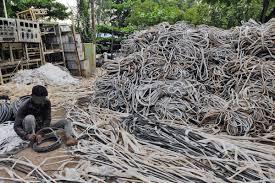
Banner image: A worker separates the plastic covers from recovered wires from dismantled ships in Chattogram. Image by Abdullah Zahid Osmani, TIB.
NOTE – This article was originally published in Mongabay and can be viewed here