Image Courtesy – Sabrang India
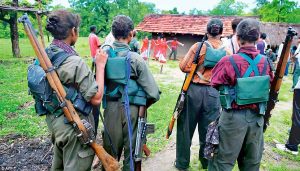
On the 3rd of April, this year, there was a massive attack by the Naxalites on the team of CRPF, which went for an operation in Bijapur in Chhattisgarh. In the incident, 22 jawans were martyred and many more got injured, some of them seriously.
There have been regular incidents of this nature in those areas, sometimes minor and sometimes major. What is the genesis of this issue, and what are the solutions? Why governments in the last more than fifty years couldn’t control the insurgencies, occurring so frequently.
“Buy Organic Products Online at best prices at http://www.getgreen.co.in “.
Naxalites, tracing their origin to a radical peasant uprising issue against landlords in West Bengal in 1967, today rule the best forests of India. Controlling a region, stretching from the Indo Nepal border to coastal Andhra Pradesh, an area two and a half times the size of Bangladesh had spread very fast from a small village to ten states.
Despite the massive operations by paramilitary forces, they have continued to spread into new areas. They have established parallel governments in these areas. People in these areas have begun to trust them instead of the government, out of fear and security of their livelihood.
On one side is the elected government with a fractured and corrupt system, and on the other side is a band of armed people on their doors to solve their problems at gunpoint. Caught between the warring groups, the tribal people prefer the latter, because they are fast and accessible, and also gives ensured access to their livelihood.
Read Also : Development or Destruction – Where we are heading to!
On December 13, 1946, during a debate on the Objective Resolution, which went for a week, a former hockey player and lapsed Christian named Jaipal Singh spoke before the stalwarts, namely Purushottamdas Tandon, Shyama Prasad Mukerjee, B.R. Ambedkar, M.R.Jaykar, M.R.Masani, Hansa Mehta, Somnath Lahiri, and Jawahar Lal Nehru, “As a junglee, as an Adivasi, I am not expected to understand the legal intricacies of the Resolution. But my common sense tells me that every one of us should march on that road to freedom and fight together.
If there’s any group of Indian people who have been shabbily treated, it is my people. They have been disgracefully treated, neglected for the last 6000 years. The history of Indus Valley Civilisation, a child of which I am, shows quite clearly that it is the newcomers, most of you here are intruders. As far as I am concerned, it is the newcomers who have driven away my people from the Indus Valley”.
There are 85 million Indians who are officially classified as “Scheduled Tribes”. Of these, about 15 million live in North East India. The rest of the 70 million tribal live in the heart of India in a more or less contiguous hill and forest belt that extends across the states of Gujrat, Rajasthan, Maharashtra, Madhya Pradesh, Chhattisgarh, Jharkhand, Andhra Pradesh, Bihar, and West Bengal.
All the tribes of central and eastern India share certain attributes in the form of cultural, social, economic, and political, or we can treat them as a single segment. This commonality is conveyed in the term “ADIVASI“. But this word is not used for Naga or Mizo from NE India, but Gond, Korku, Bhil, or an Oraon, the tribes from central India.
The term Adivasi is a Sanskrit word. In Hindi, Adivasi mean original inhabitants. Adi means beginning and Vasi means dweller, thus literally meaning beginning inhabitant.
Long back, the tribal people withdrew into the forests to save themselves from the onslaught of so-called civilizing influences, firstly from Aryans, Muslims, then white British and finally current Brown Sahibs. They hid in forests and kept to their original lifestyles, value system and remained ethnic of extraordinary low level of livelihood.
They survived by largely having a very strong community sense, development of traditions, customs, usages, and rituals. They have stuck to their ways of life and preserved their ecological systems. They could do so because there was nothing to pollute their environs and had enough food of the kind they wished to survive and replicate.
The tribals of the mainland live amidst India’s best forests and alongside many of the fastest flowing rivers. Moreover, they are controlling the richest mineral resources. This closeness to nature’s bounty provides them the means for subsistence and survival.
Post-independence, in the 1970s, tribal people came under intense land pressure, especially in central India. It was the time when forests were auctioned to obtain timber and planned for large projects. Migration into tribal lands increased dramatically. Tribal people lost their titles to their lands in many ways, LEASE, FORFEITURE from debts, BRIBERY of land registry officials.
Other non-tribals simply squatted or even lobbied governments to classify them as tribal to allow them to compete with the original tribals. Most of the tribal members became landless laborers in the 1960s and 1970s. The region that a few years earlier had been the exclusive domain of tribals, now was a mixed population of tribals and non-tribals.
Read Also : How the ‘Orange Areas’ Dispute in Central India Leaves Dalit, Adivasi Farmers Without Land…
For tribal people, the land had been viewed as a common resource, free to whoever needed it. By the time tribals accepted the necessity of obtaining formal land titles, they had lost the opportunity to lay claim to their land, which might rightfully have been considered theirs only. In the early 20th century, large areas fell into the hands of non-tribals on account of improved transportation and communication.
Around 1900, many regions were opened by the British government to settlement through a scheme, by which inward migrants received ownership of free land in return for cultivating it. Tribals are the unacknowledged victims of post-independence democratic development.
Their relative condition is more striking when compared with that of other disadvantaged groups, such as DALITS and MUSLIMS. In shaping the national discourse on democracy and governance, the tribals remain not only marginal rather invisible.
Adivasis constitute roughly 8 % of India’s population. The sociologist Walter Fernandes estimates that about 40% of those displaced by government projects are of tribal origin. It means that a tribal is five times vulnerable to be displaced as a non-tribal to be forced to sacrifice his home and hearth by the demands of development.
The tribals have been dislodged from their traditional source of livelihood and place of habitation. They joined the ranks of landless laborers and without any training, equipment, or aptitude for any skilled or semi-skilled job.
The result is, they are not only losing command over the resources which support their lives but also facing social disorganization which is unprecedented in history. Our civilized society and the government have failed to understand the pain, provide a life of dignity and honor to its tribal citizens.
How we articulate a problem, defines the quality of the solution. Naxal’s problem can’t be seen merely as an issue of insurgency. It’s the reflection of the government’s approach to development. It’s the neglect of tribals, its greed to extract minerals and water for building dams on any term by displacing them, violating environmental norms, and having no regard for the right of ordinary people.
We need to give a humane touch and must not treat them as terrorists and anti-national elements en masse. A mix of patience, firmness, and effective governance is required to bring them into the mainstream of Indian polity and enable them to enjoy the fruits of a vibrant democracy.
Tags: #adivasi, #communist, #getgreengetgrowing, #gngagritech, #greenstories, #IndianPolitics, #naxal, #naxalbari, #naxalite, #naxalites, #politics, #rajeevkhandelwal, #rajeevkhandelwalfandom, #urbannaxals, #worldpolitics, #zee