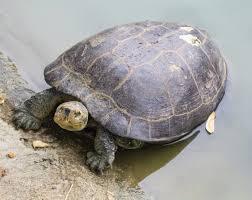

A new study has found that turtles with jaws strong enough to crack open snails and clams were far more likely to survive the asteroid impact that killed the dinosaurs.
The findings show that when ecosystems broke down after the impact, turtles that could feed on these resilient prey had a critical survival edge.
A striking pattern emerges
Across the turtle lineages that straddled the extinction boundary, a striking pattern emerged in the skulls and jaws left behind.
Reading those structures against survival itself, Serjoscha Evers at the Bavarian State Collections of Natural History (SNSB) tied crushing diets to the turtles that made it through.
The advantage did not belong to every survivor, but it appeared often enough to mark hard-shelled prey as one of the clearest threads in the story.
That made diet more than a detail of turtle life, and it opened the deeper question of why this menu held up when so much else failed.
________________________________________________________________________
The link between jaws and diet
Broad jaw ridges and blunt biting edges carried the clue hidden in those skulls all along.
Those crushing surfaces signaled durophagy, a diet built around hard-shelled prey, rather than slicing fish or cropping plants.
Because living turtles show the same link between jaw shape and diet, fossil skulls can preserve feeding habits.
That evidence let the team compare survival against diet without treating every successful turtle as an identical survivor.
After the darkness
After the Chicxulub impact, Earth entered a brutal interval of darkness, cooling, and badly reduced sunlight.
Climate models show soot could shut down photosynthesis for years, starving land plants first and followed by many animals.
Snails, clams, and other bottom-feeding opportunists had better survival rates in harsh conditions, leaving some turtles with dependable meals.
That helps explain why a specialized menu became a shield instead of a weakness during a disaster.
The odds of survival
From the team’s analysis, about 90% of shell-crushing turtles crossed the boundary, while non-crushers survived at roughly 63%.
That difference meant the shell-crackers had roughly 4.2 to 6.5 times better odds of survival overall.
“We are observing an ecological filter. Specializing in hard-shelled food gave these turtle species an evolutionary advantage,” said Evers.
Those numbers put a hard edge on an idea paleontologists had long suspected but had never tested directly.
Not all shell-cracking turtles survived
Shell-cracking was not a magic pass, and several turtles without that diet still survived the extinction.
Herbivores were hit especially hard after plants crashed, and fish hunters also faced food webs stripped of energy.
“Herbivores had difficulty surviving in the nuclear winter following the impact, with effects on the entire food chain, including carnivores,” said Evers.
That boundary matters. Diet raised the odds, but never acted as the only gatekeeper.
Water with edible life
Water itself also tilted the odds, because freshwater settings buffered animals from the worst collapse on land.
A broader record of turtle extinctions still places the asteroid aftermath among the group’s two biggest losses.
Terrestrial turtles suffered more losses, while aquatic lineages kept feeding through detritus, the dead organic leftovers at the bottom of rivers and ponds.
That wider ecological cushion helps explain why diet mattered most within waters that still held edible life.
Many paths converged
Shell-crushing did not appear once and then simply persist, because turtle history has produced the same solution again and again.
Across the turtle tree, the trait evolved at least 27 times as different groups built broad crushing jaws.
That repeated arrival matters because it shows the feeding style was reachable, not a quirk of one lucky branch.
Even so, transitions into shell-cracking were rarer than losses of that habit, which kept the specialists uncommon.
________________________________________________________________________
Where uncertainty remains
Fossils seldom capture every detail that researchers need, and many turtle lineages remain known only from incomplete remains.
Jaw bones matter most here, because shells alone usually cannot reveal whether an animal specialized in hard prey.
Some survival calls also depend on family-tree branches that cross the boundary even when fossils vanish for a time.
That means the pattern looks sturdy, but the exact strength of the advantage could still produce new discoveries.
Critical fossils are missing from the record
Critical skulls from the last million years of the Cretaceous era remain scarce, especially for species known only from shells.
New finds could reveal overlooked shell-crushers, erase some assumed specialists, or narrow the timing of who crossed the line.
Researchers also want to sort freshwater and marine settings more carefully, because each food web likely recovered differently.
That finer map could show whether the winning diet worked everywhere or mainly in habitats where edible bottom life rebounded fastest.
A clear pattern emerges from the fossils: when sunlight declined, turtles that fed low on more resilient aquatic food chains endured.
The result offers a clearer target for future fossil hunts and a reminder that survival often depends on what remains edible.
The study is published in the journal Biology Letters.
NOTE – This article was originally published in Earth and can be viewed here