Stephen Alter, who recently won the Himalayan Echoes Nature Prize, has often put the young, fold mountains at the centre of his writing. Other chroniclers, from Peter Matthiessen to Namita Gokhale, have written about the reality of living in a region which inspires both awe and fear

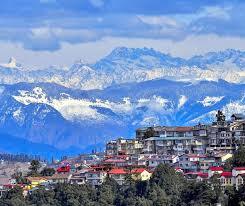
A view of the snow covered Himalayas mountain range, as seen from Shimla, in 2022. | Photo Credit: PTI
Writer and naturalist Stephen Alter has been honoured with the inaugural Radisson Himalayan Echoes Nature Prize 2025 for his contribution to Himalayan literature and conservation. Alter has often put the Himalaya at the centre of his books, and it’s the perfect time to read up on the world’s tallest mountain range on earth, and why as Alter contends, the focus must not be on altitude alone.
In his Wild Himalaya: A Natural History of the Greatest Mountain Range (Aleph), he says that at times, “these mountains seem almost alive for they are always changing.” The Himalaya, he notes, contains places of terrifying beauty, vertiginous terrain and extremes of weather that inspire both awe and fear. Alter maps the Himalaya, which spans a distance of roughly 2,500 kilometres in length and between 350 and 150 kilometres in breadth and stretches across five nations — China, Bhutan, India, Nepal and Pakistan.
Over eight sections, Alter goes through the origins of the range, its weather systems, flora and fauna, expeditions of other mountaineers and travellers, and myths and legends associated with the mountains. For him, the simple act of retelling these stories becomes an affirmation of nature’s diversity and an argument against extinction.
_______________________________________________________________________
Read Also : Himalayan Glacial Lakes Grew By 9.24% in 14 Years: Central Water Body Report
________________________________________________________________________
Goat dung ‘soft as a mattress’
In the section, ‘Flora Himalensis’, he “stalks” the carnivorous sundew or the Drosera peltata at the Jabarkhet Nature Reserve near Landour in Uttarakhand. Drosera means “dew of the sun” and it gets this name, says Alter, because the mucilage on its leaves is similar to tiny drops of dew. The saliva-like substance traps insects, and after the victim is captured, the leaf closes around it and consumes the insects.
He writes about encountering a tiger barely 10 metres away on the banks of the Ram Ganga river in Corbett National Park and sleeping on a “layer of goat dung, 15 cm deep and soft as a foam mattress” at Shingo La in Ladakh while trekking through Zanskar Valley.
On the eastern flank of the mountain range, he spots blood pheasants in Kanchenjunga, the takin, an animal related to goat antelopes, in Bhutan, and black-necked migrating cranes at Phobjhika. Amid the treasure trove, are photographs, say of the magnolia blooming in Arunachal Pradesh and the Machapuchere at sunset, and the books trail he leaves, from George Schaller’s Tibet Wild, Maharaj K. Pandit’s Life in the Himalaya: An Ecosystem at Risk, D.N. Wadia’s Geology of India, Asia ke Peeth Par (On the Shoulders of Asia) by Shekhar Pathak and Uma Bhatt and many others.
Alter mentions Schaller’s “special affinity” for snow leopards, the highest roaming of the big cats. Schaller had once come face-to-face with a snow leopard that left him with a “haunting sense of its elusive beauty and the way in which it seemed to dissolve into rocks and snow.”
Elusive leopards
Leopards find place in Janhavi Prasada’s wonderful new book, Nainital Through Memory, Stories & History (Roli Books). Walking in the scenic hillsides across the Himalaya region “calls for the alertness of a leopard,” she says. In the forest, keep talking — even if it means talking to yourself, she advises, because the murmur keeps lurking wild animals at bay. “Unlike the tiger which kills in daylight, leopards fear humans in the day, but after dark they prowl in search of prey.” In the hills, not a day goes by without mentioning a leopard.
In ‘Faces of Nainital: Past and Present’, we run into Corbett, the Bakshis who came from Pakistan, four prominent Parsi families, Mrs. Bastien, the last Anglo-Indian in town, others from the Christian community, the women from the mountains, icons like Sundar Lal Bahuguna, and Shekhar Pathak who has “dedicated his life to understanding the past, present and future of the Himalaya.” He is trekking the same trail for the third time to catalogue the river paths of the Himalaya, “an exercise done every decade to study the impact of climate change over the years.” Digvijay Singh’s illustrations add to this profile of a town’s layered history and culture.
The many raconteurs of the Himalaya, from Peter Matthiessen, Bill Aitken, Ruskin Bond to Anuradha Roy, Namita Gokhale, Manjushree Thapa and Bulbul Sharma, have written about the reality of life in the mountains. In Himalaya: Adventures, Meditations, Life (Speaking Tiger), edited by Bond and Gokhale, Bond writes in the Preface that living in the mountains is not a romance for everyone. “Even so, the mountains have become very personal to me, as they have to other writers who have made their homes here [in the Himalaya].” The Himalaya’s foremost teaching? Bond says it’s perhaps humility; “We know that just living, and helping our fellow creatures through life, is enough; it is greater than any art.”
Women of the hills
The last in the excellent Zubaan series on lives of women in the Northeast features writings from Sikkim and Darjeeling Hills. Beneath Magnolia Skies, edited by Mona Chettri and Prava Rai, includes the voices of homemakers, students, teachers, professionals, artists who ask pertinent questions, as articulated by the editors. “As Himalayan women move between tradition and modernity, how do culture, tradition, and patriarchy reconcile with their futures?; What shapes and forms do inequality, violence, and prejudice take? How do culture, politics, and society make them invisible? How do women claim space, agency, and voice within a society that keeps them marginalised?”
_______________________________________________________________________
Read Also : When the Monsoon Crossed the Mountains and reached Tibet: A Himalayan Climate Shift
________________________________________________________________________
Anshu Chettri wonders why we seldom see women loitering around alone, as she goes walking around the Himalayan town of Kalimpong. She relishes her freedom to walk at her own pace. The town made her aware of its struggles like the water scarcity in almost every household.
Talking to The Hindu about his book Himalaya: Exploring the Roof of the World (Bloomsbury), John Keay said the Himalaya region is a distinct eco-zone and must be protected. Alter is disturbed at seeing hundreds of greater adjutant storks perched on huge piles of burning rubbish on the outskirts of Guwahati. “…the grim birds look like creatures out of an apocalyptic image.”
Learn from the mountains, urges Gokhale. “…what remains in the end is the sense of intimacy, the exhilaration, and yes, the desolation, of these rugged mountains, the ‘self born mockers of man’s enterprise’.”
NOTE – This article was originally published in THE HINDU and can be viewed here