&imwidth=800&imheight=600&format=webp&quality=medium "India's Green Mirage: Northeast is quietly losing its forest cover while India celebrates gains")
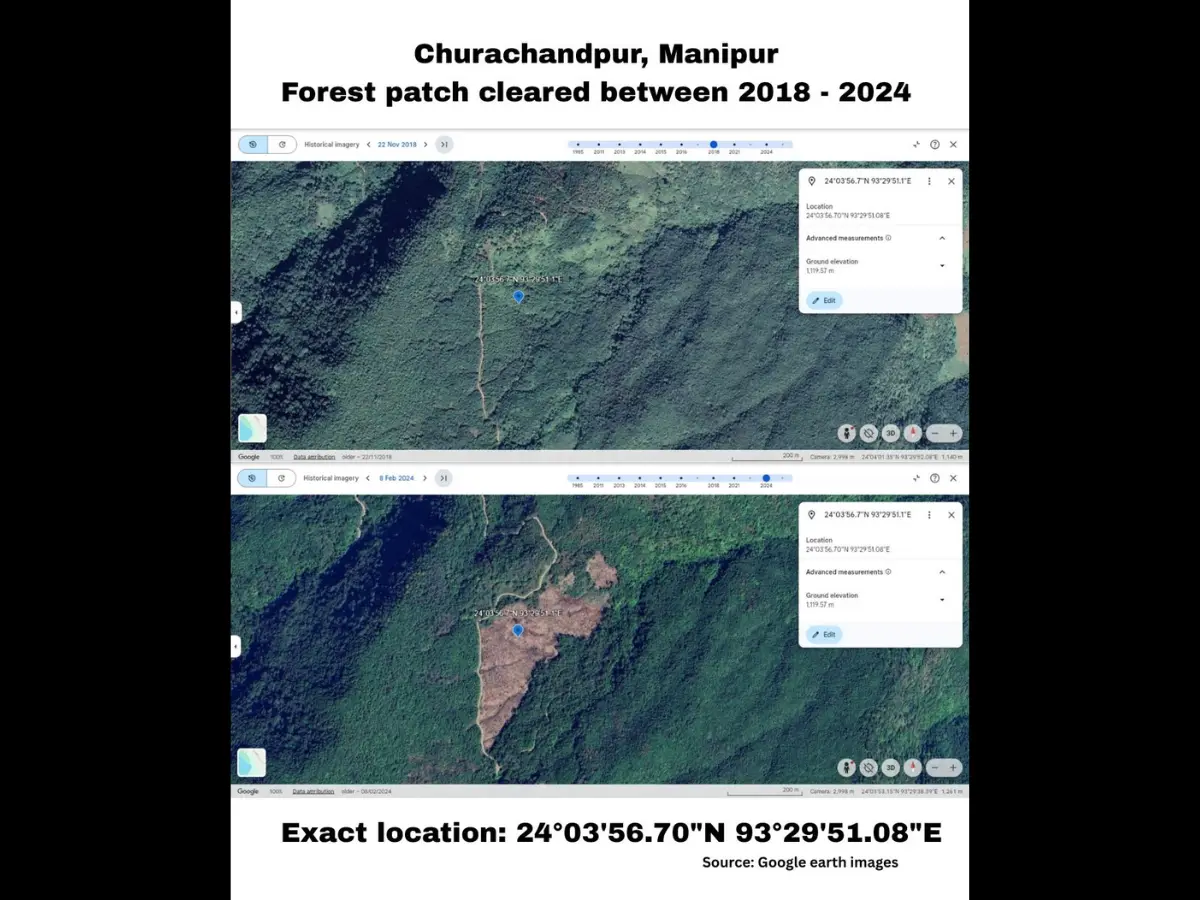
Forest patch cleared between 2018-2024 (Image verified via Google earth historical images)
Five Northeastern states account for 60 per cent of India’s tree‑cover loss even as national forest areas appear to grow. WION investigates how governance collapse, narcotics economies and policy blind spots are reshaping the region’s forests, and its future.
India has a forest success story to tell. According to the Food and Agriculture Organization’s Global Forest Resources Assessment 2025, the country ranks third globally in annual net forest area gain, adding approximately 191,000 hectares of new cover every year between 2015 and 2025. It is a number India’s policymakers cite with pride, and rightly so.
But move to the country’s northeastern edge, where eight states collectively hold nearly a quarter of India’s entire forest cover despite occupying less than eight per cent of its land, and the picture changes. According to Global Forest Watch, five Northeastern states alone are responsible for 60 per cent of India’s total tree cover loss between 2001 and 2023. The India State of Forest Report 2023, the latest official assessment released in December 2024, recorded a further loss of 327 square kilometres across the region between 2021 and 2023. In the preceding cycle, the Northeast had already lost approximately 1,020 square kilometres, the highest regional loss recorded anywhere in the country that period.
________________________________________________________________________
The Roots of the Crisis: When Governance Fails, Forests Follow
To understand why the Northeast’s forests are disappearing, WION reached out to Bah Phrang Roy, former Assistant President of the United Nations’ International Fund for Agricultural Development and founder and chairman of the North East Society for Agroecology Support, one of the region’s most respected voices on indigenous land governance. He points not to one cause but to a structural collapse decades in the making.
“The landscapes of Northeast India are a complex mosaic of fields, fallows, pastures, and forests, traditionally sustained by Indigenous Peoples through governance systems rooted in sharing, caring and collective wellbeing,” he told WION. “Today, the rapid loss of forest cover in the region reflects a deep structural crisis: the erosion of community governance.”
The drivers Roy identifies are multiple and interlocking. Decades of demonising shifting cultivation, the traditional jhum system that, when practised with adequate fallow periods, allowed forests to regenerate naturally, pushed communities toward chemical-heavy monocropping and commercial plantations. Fallow periods shortened. Natural regeneration stopped. The land’s capacity as a carbon sink and water reservoir collapsed.
Simultaneously, land privatisation accelerated. “There has been a steady rise in privatisation since the colonial period,” Roy told WION. “Large tracts of forest are now falling under private control, often concentrated in the hands of local elites. These privately held lands frequently lie outside the purview of community laws and customary regulation, accelerating deforestation.” The institutions meant to govern community forests, Autonomous District Councils, remain, in Roy’s assessment, severely under-resourced and constrained, creating a gap between rights on paper and governance on the ground.
His diagnosis cuts to the heart of a broader failure. “Specialists and technocrats often understand their mission as the relationship between markets and the State,” he said, referencing economist Raghuram Rajan’s framework of the three pillars of society. “But very often they neglect the third pillar, the web of values, governance norms and human relations within a community. To reverse ecological failure, we must integrate traditional ecological knowledge with formal policy and ensure that Indigenous Peoples communities are empowered to manage their ancestral lands on their own terms.”
What the Loss Is Costing: Climate, Water and the Brahmaputra’s Future
The consequences of forest loss in the Northeast are not abstract. They are already arriving, in dried springs, intensifying floods and destabilising river systems that millions depend on.
“The forests of Meghalaya are more than just trees, they are the lifeblood of the entire subcontinent,” Roy told WION. “Mountain springs, locally known as wahduid, are drying up at an alarming rate. As deforestation thins the canopy, the soil’s sponge effect vanishes, reducing groundwater recharge and degrading soil health.”
The downstream consequences are severe. Siltation is raising riverbeds, making Brahmaputra floods more frequent and intense. Steady monsoons are being replaced by extreme burst events, and without forest cover to absorb them, those rains trigger immediate flash floods and devastating erosion. “Because Meghalaya shares a border with Bangladesh, this is a transboundary crisis,” Roy said. “The degradation of Northeast forests is no longer just an environmental issue, it is a full-scale water security and climate emergency.”
The Pressures Nobody Is Talking About
While illicit cultivation draws significant attention, Roy argues that the most underreported driver of forest loss is the cumulative impact of what appears, individually, to be minor, but collectively is transforming landscapes at a scale that escapes policy attention entirely.
“While illegal mining and large infrastructure projects tend to dominate public discourse, the most underreported and least understood pressure is the cumulative impact of small-scale but widespread interventions, road expansion, sand mining, and the gradual spread of cash crops and monocultures,” he told WION. “Individually, these may appear minor or even developmental, but collectively they are transforming landscapes at a scale that often escapes policy attention and environmental assessment.”
Illegal coal mining continues despite Supreme Court and National Green Tribunal bans, Roy notes, operating under the protection of powerful networks linked to criminal interests. Large infrastructure projects are accelerating simultaneously, including a proposed 166.8-kilometre Greenfield High-Speed Corridor through Ri-Bhoi district in Meghalaya, a region with over 80 per cent forest cover, as per Roy.
The human cost is equally profound. “As forests degrade, Indigenous Peoples’ Food Systems weaken, reducing access to wild foods, medicinal plants, and forest-based livelihoods,” Roy told WION. “This not only affects nutrition and income but also erodes cultural practices rooted in reciprocity, sharing, and collective stewardship. Displacement is increasingly pushing people, especially youth, to migrate to urban centres, disrupting their connection to land, culture, and traditional ecological knowledge systems, leading to a gradual but significant loss of identity.”
Manipur: Where the Numbers Become a Crisis
Nowhere in the Northeast does every dimension of this story converge more sharply than in Manipur. Between 2019 and 2021, the state recorded approximately 249 square kilometres of forest loss, the highest absolute loss in the region during that cycle. The ISFR 2023 shows a further 47 square kilometres lost between 2021 and 2023. The Safe Environment Campaign Committee, drawing on three successive ISFR cycles, estimates Manipur has lost approximately 883 square kilometres of forest since 1987, with roughly 91 per cent of that loss occurring in just the last six years.
It was former Chief Minister N Biren Singh, who governed the state from 2017 to 2025, who publicly called on WION to examine the crisis, responding to the channel’s coverage of Indonesia’s deforestation emergency. “It’s a bit disheartening to see the situation in Manipur, India, receiving little to no serious attention, either nationally or internationally,” he wrote on his verified social media handle. “The scale of deforestation during this short period of crisis is clearly visible in recent satellite images. If climate change is truly a global concern, then what’s happening here deserves equal urgency and visibility.”
In an interaction with WION, Biren Singh described what his administration confronted from inside the government. “From within the government, it became evident early on that illicit poppy cultivation was not just a law and order issue, but a deeply entrenched threat to Manipur’s ecological balance, social fabric, and long-term development. This is precisely why my administration launched the War on Drugs mission, elevating the fight into a defining effort to reclaim the future of our state. It was not treated as a routine enforcement exercise, but as a focused and sustained campaign,” he said.
The results were measurable. His administration’s campaign led to confiscation of drugs and related assets worth nearly Rs 60,000 crore. “Through sustained monitoring and data-driven interventions, we exposed the scale of what had been allowed to grow unchecked, a rapidly expanding network degrading forests, damaging soil, and contributing to floods,” Biren Singh told WION. “It is about protecting our forests, saving our youth from addiction, breaking the financial backbone of insurgency, and restoring dignity and opportunity to our indigenous communities.”
The insurgency dimension is direct and documented. Manipur shares a border with Myanmar, part of the Golden Triangle, one of the world’s largest opium-producing regions. “The Indo-Myanmar border has practically remained open since this country was formed,” Biren Singh said. “The Free Movement Regime allowed travel without a visa up to 16 kilometres across both sides of the border, which significantly contributed to the movement of people possessing both the skill and the trade of poppy cultivation into my state. There has been an agenda to actually shift the Golden Triangle from Myanmar to Manipur. We reached this conclusion from various indications. The remote, hilly terrain is challenging to reach or monitor by law enforcement agencies; the porous border provides various advantages to armed groups and drug cartels.” The Free Movement Regime has since been scrapped and border fencing is underway, he said.
The scale of the narcotics-driven deforestation in the wider region has now been officially confirmed through government data. According to records provided to WION under the Right to Information Act by the Central Bureau of Narcotics, Ministry of Finance, destruction operations against illegal poppy plantations in Arunachal Pradesh alone covered 7,847 hectares across Namsai, Changlang and Lohit districts in 2025, up from just 465 hectares in 2017 when operations began in earnest. Teams conducting those operations received direct death threats from NSCN (K-YA) and ULFA (Independent), confirming these groups held direct financial stakes in the fields destroyed.
Satellite imagery documenting widespread deforestation across the Northeast, prepared by the Asia Supporting Organisation Alternative Plant for Opium Poppy and shared publicly by Biren Singh, showed before-and-after comparisons of forest cover in Tengnoupal and Pherzawl districts, with deforestation ranging from 0.09 to 1 square kilometre across individual mapped coordinates.
________________________________________________________________________
What Needs to Change, Before It Becomes Irreversible
Bah Phrang Roy’s message to India’s government and the international community is direct and unsparing. “Indigenous communities are not drivers of ecological degradation, they are custodians of some of the most biodiverse and resilient landscapes in the Northeast,” he told WION. “Yet current policy frameworks tend to marginalise them, resulting in interventions that undermine both ecosystems and livelihoods.”
The course-correction he calls for is fundamental. “Governments both in India and globally must actively support Indigenous Peoples governance systems as equal and legitimate, and move away from extraction-led models of development toward landscape-based, community-led approaches,” Roy said.
This includes formal recognition of customary tenure, adequate resourcing of Autonomous District Councils, and direct financial mechanisms that allow communities to lead their own conservation. “Excluding them from governance not only leads to ineffective policies, it accelerates ecological and social breakdown.”
His closing assessment carries the weight of a lifetime of work across the region. “The Northeast stands at a critical juncture. Without immediate course correction and a promotion of nature-positive Indigenous Peoples food systems, the region risks irreversible damage. But if Indigenous Peoples communities are meaningfully empowered, their knowledge, systems, and values offer one of the most viable pathways toward restoring balance, both for people and the planet.”
Former chief minister Biren Singh’s warning echoes from the political ground. “The challenge facing Manipur is not confined to one state. It has serious implications for the entire nation and the wider region. What begins in the hills of Manipur can easily spread across borders and ultimately threaten the social and economic fabric of the country as a whole,” he told WION. “My administration has already undertaken the heavy lifting. However, this cannot be addressed in isolation. All stakeholders, including the central government, security agencies, and the international community, must give serious and sustained attention to this issue. A coordinated and determined response is essential to ensure that the threat is contained before it becomes irreversible.”
A Developing Story
WION filed RTI applications with the Forest Survey of India, and Central Bureau of Narcotics, seeking district-wise deforestation data, poppy eradication records and official assessments across the Northeast. The Central Bureau of Narcotics has responded with official year-wise, district-wise destruction data from 2015 to March 2026. The Forest Survey of India said it holds no internal documentation recording specific causes of forest cover change in Manipur and Arunachal Pradesh, which raises questions about the government’s capacity to explain its own data.
This investigation is ongoing. In the next part of this series, WION will analyse the official narcotics eradication data obtained via RTI. It examines what the Forest Survey of India’s own records reveal about India’s forest governance, and asks why the country tracking its narcotics war with precision cannot explain the forest crisis unfolding on the same maps.
NOTE – This article was originally published in WION and can be viewed here